Wednesday, August 27, 2014

Back in the UAE

So I am (back) in Abu Dhabi for a week. It's summer (although not the hottest part) and the temperature hovers in the low 40's (C) during the day. Everyone retreats to the air-conditioned comfort of some luxury hotel, their luxury car, or a luxury shopping mall. Everyone that is, except for the migrant construction workers who are still being bused* to and from their non air-conditioned quarters (which, complete with corrugated iron roofs, make ideal saunas) in non air-conditioned buses. At least the bus windows open.

I am inside all day since I'm working. I don't venture outside until the late afternoon, when the sun's direct heat has retreated and I only have the 40 degree heat to deal with. I want to cross the road outside the hotel but it's turned into something like a ten-lane divided freeway since the opening of the Salam Street tunnel. Luckily I remember how Abu Dhabi has a network of pedestrian subways (rarely used, since there are relatively few pedestrians, and apart from the subways, not much pedestrian-friendly ground to walk on). These are grandly built with walls of tiled artwork. Like much of the infrastructure, maintenance and longevity are less of a concern, so things degrade quickly. Paving and brickwork is cracked and broken, drains, when there are any, are blocked or broken (or uncovered). A pity.
Pedestrian underpass - desert camel racing scenes in this one

* Annoying, isn't it? When you write an apparently simple word and all of a sudden your thought flow comes to a crashing stop when you can't convince yourself whether you've spelled (or spelt) it correctly! Being transported by a bus (of which more than one would be buses, while 'busses' is tempting) is being bused. But that looks a lot like 'abused' without the 'a', so can it be correct? A quick search digs up 'buss', which is a form of oral communication, so being 'bussed' is definitely something different to being transported mechanically. So 'bused' it is then.

Dubai police car - if you can't beat them, join them!
Here the people's car is a Toyota Landcruiser - the most expensive V8 model of course. In white. Given that there's so many BMW X5 and X6s and Range Rovers on the roads they are now a bit passé. The Porsche Cayenne is still popular, although you'll definitely not stand out in the crowd driving one of those. Having a Porsche is not something particularly special here. Something more exotic (and expensive) is required. Perhaps an Audi R8, or why not a Bugatti Veyron or Lamborghini?

In a country where the police (in Dubai) have cars like a BMW M6, Mercedes AMG SLS, and Lamborghini Aventador, you need to make the effort to stand out from the crowd with your car.

I am staying in one of the luxury hotels on the island. Actually "luxury hotel" is almost a tautology here; every hotel is "luxury" by the standards of any other place. The forecourt is - as is the norm - crowded with valet-parked fancy cars: from BMW and Mercedes to Porsches, Bentleys, the odd Aston Martin and Ferrari. Footpaths are for cars, not people and to get to the front door you have to negotiate this parking lot. I meet up with some old colleagues. One arrives in his Porsche and the other turns up in his Aston Martin DB9. And there I am thinking that when I had a car here I was driving a Nissan Tiida....
A novel use of 4WD to get over the traffic?

The class I am teaching is almost monochrome. I look out at a sea of white on one side and black on the other. Boys on one side in their white dishdashes (traditional male dress) and the girls on the other side in their black abayas. An occasional splash of colour is provided by the few expatriates in the class. Coffee breaks inevitably turn into very  lengthy affairs. Speaking of coffee, one morning one of the girls pulls out a Harrods bag and from it produces a large decorated ceramic coffee pot (with gilded decoration), a doily, and a set of ceramic coffee cups. I'm impressed. When I question her about it, she explains: "It's local coffee - I couldn't live without my coffee". She proceeds to offer coffee to others and the coffee break turns into a long local social event. The room is always fragrant, smelling of the typical woody local perfumes of oud and bukhoor, which are worn liberally by the men.

At dinner at one of the restaurants I am, as usual, dining alone. So I engage myself in some people watching which waiting for my meal. There's a young Emirati couple. He's in his sparkling white dishdash; she's in her black abaya, carrying the de rigueur large and obviously expensive handbag (with a large gold chain) and large sunglasses. It always impresses me when people wear sunglasses indoors. The couple arrives, are seated, and proceed to extract their smartphones (she from her handbag, he from the specially-designed pocket in his dishdash). I briefly reflect on whether traditionally, when people were still riding camels and living a nomadic life in the desert,  the dishdashes had phone-pockets. The restaurants "no shorts or slippers" dress policy clearly doesn't apply to the sandals traditionally worn by the local men.

Neither has said a word to each other; they are engrossed by their smartphones. They are briefly interrupted by the waitress - who, of course, is Filipino, like virtually all hospitality staff in the UAE - and then revert back to their phones. Throughout the entire meal they are engaged with their phones, but not each other. And while I eat my meal I'm wondering how it is that Emirati men manage to keep their dishdashes so brilliantly white and free of creases.


Sunday, August 24, 2014

You call this summer?

Before you point it out, I realise that two months is a long time between posts. And a lot of post-able things have been happening in my travelling life so no excuses there (except perhaps the fact that, with all the travelling, there's been little time for posting). So much for preamble.

When we last met, I was taking a decidedly long time to cover little ground - pedalling my way across northern Spain. Since then I've added several thousand more kilometres at a more rapid pace - by car. Including, coincidentally in fact, quite a few thousand kilometres back in Spain. But more on that in another post.

My most recent journey took me even further in even less time, travelling this time by air for something like six and a half hours and covering 5,300km. And this exercise nicely highlighted how summer in one place can mean something entirely different to summer in another. In my case, leaving France on a decidedly fresh "summer" morning of 10 degrees (C) and arriving at ten o'clock in the evening in Abu Dhabi in the "cool" evening of 39 degrees. (Daytime temperatures at the moment in Abu Dhabi are in the low to mid 40's).

I would have arrived in Abu Dhabi earlier, but the flight left almost an hour late. "Of course it did" you will be quick to point out, given that I departed from one of the world's more unpleasant and disorganised airports, Charles de Gaulle in Paris. To be fair, there are plenty of worse airports in the world: Murtala Muhammed airport in Lagos and Jacksons International airport in Port Moresby come to mind for example. But in some places your expectations are low to begin with, so when they are met you are not too upset. In Paris one has - you would like to think justifiably - high expectations. But in the case of CDG these are most definitely not met.

I'd been to Abu Dhabi before - in fact lived there - so I knew that it was hot in summer. But that still didn't prepare me for the slap-in-the-face feeling as you step off the plane into 39 degrees in the middle of the night. Of course, the fact that France was unseasonably cold for summer (or at least, they try to convince each other that it's unusual) only served to amplify the difference.

A lightly-loaded trolley at Abu Dhabi airport
Abu Dhabi airport was unusually busy; end of holidays, families getting back before the school year starts, local families laden with Hermès and Louis Vuitton bags (de rigueur in this part of the world) and so forth. The normally well-run airport was showing signs of strain and the arrivals area was bordering on pandemonium. I couldn't help taking a picture of a trolley loaded with what seemed a typical load for one person. The woman who had been pushing it - invariably it is the women who are tasked with pushing luggage trolleys, the men presumably having more important duties to attend to - was taking a break. Or perhaps she was waiting for the next bag to come off the belt.

And then I thought back to my bike ride and how little luggage I managed with for three weeks and it put things in perspective. How much stuff do we really need?

Sunday, August 17, 2014

Off to the south of Spain (again)

And now it's a year later and another road trip to the south of Spain in July/August 2014.

In Spain. Might be forgiven for thinking I'm still in Spain, but in fact since that trip I've been to France, Belgium, Netherlands. Bit difficult to get to Holland from France without going through Belgium, although it doesn't take long and apart from the naked cyclops along the motorway there's not a lot to say about Belgium. Perhaps more on that later.


28-July-2014

Getaria, Spain

29-July-2014
Bibao, Spain
Guggenheim museum, finally get to see it. Definitely worth a trip though!


30-July-2014

Burgos
Stayed here to re-live a little bit my bicycle journey along the Camino de Santiago, during which I also stayed at Burgos.

31-July-2014

Merida
01-August-2014 to 14-August-2014
Jimena de la Frontera

With a trip to Malaga and some other local trips including to Ronda


14-August-2014

Olvera: Narrow streets, had to reverse back down one. Parked and asked a woman for directions to plaza where the bar I wanted to go to was, she started to explain, then said "It's too complicated, I'll take you there" and walked with us all the way to the top of the village, up steps, around the church, delivered us there. So many friendly people.


15-August-2014
Wake up late (almost 9 am) buffet breakfast, all Spanish except for us. Leave at 10. Quiet since it turns out to be a public holiday.

Roads are great.

Terrific road from the A5 to Alvira, over the mountains. A bit of everything from long straights, twisty mountain bends, sweeping curves, etc. lots of bikes on the mountain section.


Alvira walled city, intact walls. Walk around, choose a small local bar with outdoor tables and chairs for morning coffee. Order. Nothing happens. Go inside, the guy had obviously for gotten all about us; he says 'won't be long' I say 'we're leaving' he says 'ok'. Just as well since later we find a place that unusually, sells nice pastries so we can have a pastry and coffee. Much better than the almost certainly unpleasant bocadillo we would have had. Cathedral in granite. Wooden huts like a Christmas market set up as drinking stalls with music. Detracts from the whole experience.

Segovia larger. Roman aqueduct, impressively long and high. Fancy cathedral. Coffee and a coke and toilet stop. Some but not many foreign tourists. Many French cars on the road though.

Santo Domingo de Silos
Driving along small country road, see something in the distance on my side of the road. Coming towards me. Bigger than a pedestrian, smaller than a horse or vehicle. Slow down, get closer, then realise it's an old woman pushing an even older man in a wheelchair along the road.

Dinner at hotel after waiting in vain at chosen bar/restaurant to be served

Monks chanting Gregorian chants. Baby behind us is unimpressed and voices its dislike.


Notes from along the way:


Tolls in Spain. Great example of bureaucratic idiocy. Tolls are, for example 2.19 euros, or 3.29 euros. And the attendant gives you the one cent change. He must have an enormous pile of one cent coins (which can't be used to actually pay anything, including the toll machines which don't accept 1,2,5 cent coins...

Great roads again. Lovely twisty small roads to and from Santi Domingo. The AP1 to the border from San Sebastián is absolutely marvellous, although many of those bends are impressive at the 120k limit!

16-August-2014
Crossing into France, suddenly everyone is driving at almost exactly the 110k limit, whereas a few km previously they'd still be driving at 140k in the apparently poorly monitored 120k Spanish roads.

Notice many - many - Swiss cars on the road from Burgos to the border. Most of them expensive. Odd. You almost never see Swiss cars in Europe (except in Switzerland). Then I see one with pink ribbons tied to the door handles, and I begin noticing that many of them have similar ribbons tied to rear wipers. A Wedding between rich Swiss and Spanish families?

Got stopped twice in the one day by Police. Odd. First time by Guardian civil, who when he found I didn't speak Spanish, and after checking the French plate on the front of the car waved me on with an air of 'I can't be bothered dealing with you'. Then again later in France at a standard roundabout check for papers. Oncoming cars were furiously flashing their lights and everyone miraculously driving at exactly the limit.

Spent a while in Limoges, buying crockery, as one does.

Dinner 43 euros, Brasserie du Commerce Miramont-de-Guyenne

17-August-2014


Stay at Chateau de la Cazine, Noth. An anniversary to celebrate!


Tuesday, June 17, 2014

The Financial Analysis

I hadn't defined a budget for the three-week Camino journey, although if I had, I think I would have under-spent it.

After a hard morning's ride a little splurge (at 3 euro)

Executive summary:

Food 430
Accommodation 308
Travel 247
Other 87 (after all there has to be an 'other' category in any financial analysis)
Total Cost 1,072
(all figures in Euros)

Analysis

So what's this about "Travel" costs? Didn't I pedal myself all the way? Well, apart from the rental of the bike itself (which is not included in the above figures), the travel cost reflects the costs of getting to St. Jean Pied de Port from Paris, the bus back to Santiago from Finisterre, and flying back to Paris again from Santigao. Costs to get to Paris depend entirely on where you're coming from of course, so aren't included here. By the way, you could use other gateway cities like Madrid or Porto to get close to the start / end cities.

I caught the train to St. Jean Pied de Port and flew back from Santiago airport. I was lucky that the SNCF (French trains) and the airport were not on strike. That's not as facetious as it might sound: as I type, the SNCF workers have been on strike for a week, causing all sorts of havoc. Air traffic controllers have a habit of going on strike at short notice and preferably (from their perspective) at inconvenient times for travellers.

My average daily expenses (i.e. not including the transport costs) for the Spanish section of the journey came in at a little over 33 euros per day:

Food 20.90
Accommodation 10.50
Other 1.70
Total Daily Cost 33.10
(all figures in Euros)


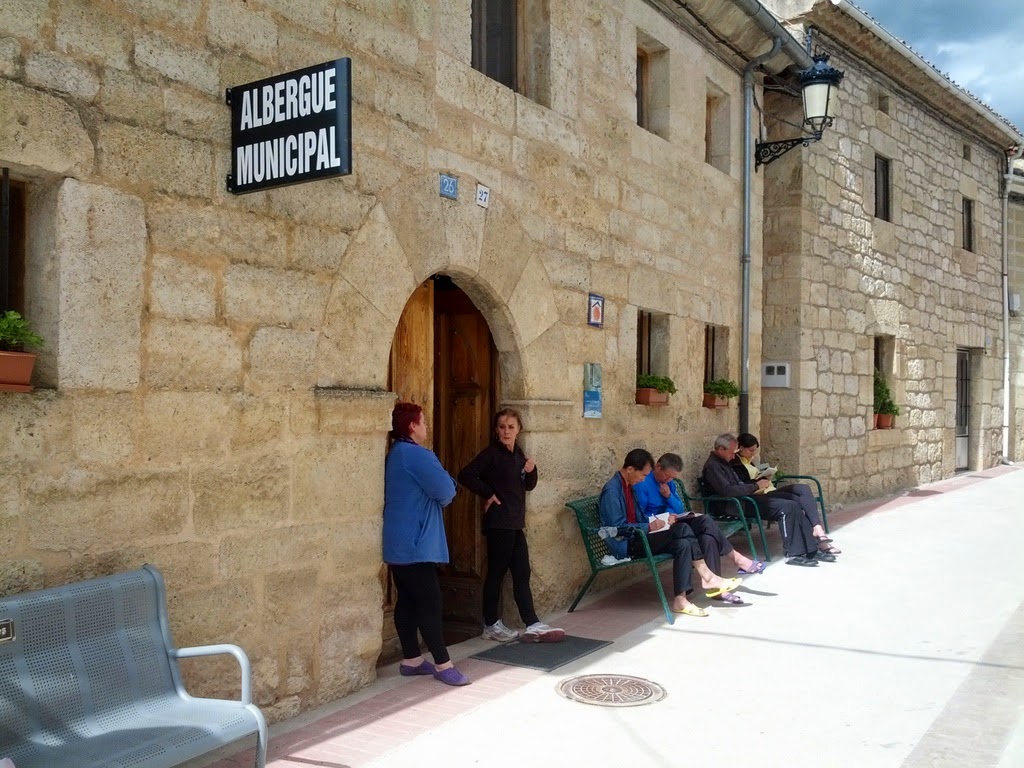
The municipal albergue in Hontanas
Staying in albergues is a really cheap way to sleep as you can see in the above figures. Of course you sort of get what you pay for, but a bed is a bed, and I found all the places I stayed at perfectly acceptable in terms of facilities and cleanliness - some significantly better than expected. On various forums you read about bed bugs; I never had any problems with this or heard of anybody who had. That's not the case for the French walking paths, where I did hear of people picking up a little bonus here and there. I think that's because there is a good awareness of the potential for the problem and preventative measures are in place in Spain (and by implication, either a lack of awareness or a lack of preventative measures in France).

The French part of the journey in my case involved two nights in a B&B (luxury, at 60 euros /night) and two restaurant dinners (Pilgrim menus, but more than two - three times the Spanish price). Keeping to good accounting practice (cooking the books?) I haven't included these numbers in the above daily averages to avoid the daily average results being skewed. My two nights in a B&B in France accounted for almost 40% of my total accommodation costs for the entire three-week trip !

Sleeping

A private albergue in Villafranca
Albergues (hostels) cost anything from nothing (really - some are "donativo" which means you pay what you feel you can afford) upwards. Most municipal albergues cost 5 euro per night. Private albergues are (slightly) more expensive, and can vary widely. I paid between 8 euro (Lorca) to 17 euro (Santiago). The municipal albergues often fill up first, meaning you're left with no choice but to stay at a private albergue. Another factor is that the private albergue are often more interesting and have their own character, making them good places to stay. If you go for pensions or hotels, well, you can pay as much as you like. But that's not really the idea of the Camino - although many people opt for a night here and there in a hotel; "a room with a door" as May, the Irish lady, had put it. Mind you, a one night splurge in a simple hotel at, say, 60 euro, is the equivalent of 10 nights in an albergue, so you need to keep that in mind when you do your sums.

Eating

A home-cooked Pilgrim Menu
The whole bottle of wine is for me
(Dessert is not in this picture)
Food is cheap; at least it is in Spain. France is another matter. The Pilgrim menus are generally around 9 - 10 euro, and that includes three copious courses, bread, and pretty much as much wine as you can drink. Not a bad deal! In France the same thing will set you back at least twice that amount. Breakfasts cost around 3 euro, and lunch, if you eat it, can be another Pilgrim menu, or simply fruit or sandwiches (bocadillos, costing around 3 euro).

You can of course opt to do it yourself as many do. Buying ingredients and preparing your own meals is certainly cheaper than even a Pilgrim meal at a restaurant, and most albergues have at least basic cooking facilities. This approach probably works best if you're in a group and can share stuff. I brought some basic cutlery and plastic "crockery" with me, thinking I might picnic along the way. But I never used any of it.

Travel

Bus transport in Spain is pretty cheap. It costs 13 euro (actually 13.10, don't ask me why, but it must make life hell for the bus driver trying to deal with all that change) for the bus from Fisterre to Santiago (a three-hour trip). It costs 3 euro for the bus from Santiago to the airport (40 minutes). I never took a taxi, but some walkers do from time to time. I imagine that would blow the budget, but perhaps less so if you shared. I saw that the cost to ship luggage to the next albergue was 7 euro.

Other Stuff

Souvenirs, extra things you buy on the way, maybe toiletries you forgot or ran out of. I bought some gaiters and waterproof over-pants in Pamplona after my Pyrenees experience. Many walkers live on Compeed for the blisters and Ibuprofen for the inflammation - all that can add up of course (although pharmacy items appear to be pretty cheap in Spain).

Depending on your perspective of course, walking or riding the Camino isn't particularly expense - certainly not if you compare it with any other form of travel. Obviously a good part of that is the saving on travel costs, since you are providing your own personal transport. Accommodation is the other big saver, as long as you're happy with dormitory living. But, as I've said before, albergues are part of the whole Camino experience - Pilgrims are not meant to travel in the lap of luxury after all! Pilgrim menus mean even eating out all the time is affordable, although you can cut this cost (which is the largest component of the total cost) dramatically by preparing your own meals. Whether the financial aspects of the Camino are an important factor is of course open to discussion.


Saturday, June 14, 2014

The Compostela

If you fulfil the minimum requirements for the Pilgrimage, your efforts are acknowledged with the issue of a certificate of completion, the Compostela. For walkers that means at least 100 km walked, and for bike riders at least 200 km ridden. On request, the pilgrim office will also issue you with a certificate of distance travelled.

My Compostela - issued on completion of the Camino
To prove that you've followed the Camino, and have walked or ridden the necessary distance, Pilgrims carry a credencial, or passport, which you get stamped at every place you stop along the way. Generally that means the albergue (hostel) you stay at overnight, but most cafés and bars along the route have their own stamp, and so it's not uncommon to collect more than one stamp per day, showing the route you took (and where you stopped for your daily café con leche fix).

My Credencial showing the places I stopped at along the way. 
My Cotolaya
 I discovered after leaving Santiago (the only place entitled to issue the Compostela, hence its full name, Santiago de Compostela) that it happened that the Franciscan church was celebrating its 800th anniversary, and to commemorate the occasion, they were also issuing their own version of a 'Compostela', although they call it the Cotolaya. As it happened, on my return to Santiago on the way home I was able to visit the Franciscan church and have my Cotolaya issued. And as a bonus, there was essentially no waiting to get it, unlike the Compostela, where I had to wait in line almost two hours before making it to the group of volunteers issuing the compostelas.

I just happened upon another blog, Annie's Simple Life, where you can find a little background on the Cotolaya (as well as a bunch of general information about the Camino - typically you find this stuff after the fact, although often it's more interesting to discover things for yourself rather than start with preconceived ideas from someone else.)


Finally, also discovered en-route by talking with others on the way, in Finisterre they also issue a certificate of completion, for those who have followed the way from Santiago through Muxia and on to Finisterre. To be eligible for this one you have to have your credencial stamped at Lires, about halfway between Muxia and Finisterre. Apparently too many 'pilgrims' were catching a taxi from Muxia to Finisterre to save themselves a day's walk, gaming the system. In case you're thinking of walking the other way around (i.e. from Finisterre to Muxia) apparently Muxia also issues their version of the certificate, so you won't miss out if you prefer to end your Camino at Muxia.

The reward for making it to Finisterre


Friday, June 13, 2014

The Engineering Review

So now that my Camino ride is over, in the best engineering tradition, here is a little review of the vital statistics and some details about lessons learnt. Let me say right out that my journey was not a race; the objective was not to go as far or as fast as possible. While I wasn't on a true religious 'pilgrimage', I did go for the chance to spend some time with myself, and to benefit from the whole experience. There were definitely some bike riders on the Camino (for example the Italian logo-lycra-clad teams)  whose objective was to 'do' the trip as fast as possible. These guys were doing 100 - 120 km per day (objective: do the trip in a week).

The Numbers

Total number of days: 18 (including one rest day in Santiago)
Total distance ridden: 1,031 km
Total time on the bike: 66.8 hours
Average speed for the trip: 15.4 km/hr

Average hours ridden: 3.9 hours/day
Average distance ridden: 60.6 km/day

Longest distance ridden in one day: 84.5 km (on the first day!)
Shortest distance ridden in one day: 34 km (second-last day)
Most hours ridden in one day: 6.2 hours (on the first day!)
Least hours ridden in one day: 2.1 hours (second-last day)
Highest average speed: 19.1 km/hr
Lowest average speed: 12.4 km/hr

Number of punctures: ZERO! A credit to the excellent tyres - in fact I had some comments on them from people who know about these things; I should have recorded the tyre details. I will also take some credit for being a little careful about how and where I rode, for example when riding on roads I tend to ride on the road and not the shoulder; it's on the shoulder that you will find all the little bits of glass and sharp stones and so on that have been brushed aside by the passing traffic.

While I am pleased to be able to say that I rode the whole (rideable) way - i.e. I rode up all the hills and did not get off and push, even though I was tempted a couple of times - when riding on the tracks, when the terrain got really rough or unsuited to the bike, I got off and walked. When you're spinning the back wheel for lack of traction going up a steep and rough track, it's time to get off.

The Bike

Riding up to 1350m and still smiling


Type of Bike: GIANT Futuro RS1 hybrid/touring bike. Front suspension, suspended seat post, Shimano SLX 30-speed, 28 inch wheels, disk brakes, mudguards (essential!), front and rear lights (essential!). In fact I added my own very bright rear LED light, and I am glad I did - it was obvious that I was being seen from a distance and several people commented on the light.

Panniers, Handlebar bag and helmet (with mirror)
Panniers: 2 x Ortlieb "Roller" 20 litre waterproof (really!) These are excellent at keeping your stuff dry, but don't have any external pockets and pouches for bits and pieces. 40 litres is enough room for all your stuff (except sleeping bag, mat or camping equipment if you're taking it).

Handlebar bag: not waterproof (really!) It's only after the first day's drenching, when everything inside the handlebar bag, including my camera, was soaked, that I discovered a little hidden pocket under the bag that contained a bright yellow plastic rain cover. I used this on subsequent rainy days. The bag detached easily from the bike ('QuickClick' I think is the brand) which is very handy when parking the bike to go into a bar for your regular café con leche. The map case on the top of the bag was very useful, even if poorly designed.

I rented the bike (a 'Comfort Touring Bike') from Bike Iberia and can absolutely recommend them. They prepare the bike to your requirements, ship it to your chosen departure point (in my case a B&B in St. Jean Pied de Port) and then when you're finished, you simply leave the bike (packed) at your final destination, let them know where it is and they come and collect it. And the customer service is brilliant. What a deal!

Favourite bike accessories

Arm warmers, reflective yellow riding wind/rain vest with zip opening (both really useful to control your body temperature, especially going up and down hills), bright LED rear light, and helmet-mounted rear-view mirror. It's amazing how many comments I got about the mirror, including from some walkers who wanted one (they are actually designed to attach to your glasses; I prefer to put mine on my helmet). I can't imagine riding on roads without a mirror - it allows you to check what's coming and also to check whether they have seen you (they put their indicators on, move over, etc.). As a related observation, I found the best drivers in terms of being sensitive to bike riders were the large trucks; they always passed with plenty of room - the same cannot be said for some car drivers.

How much stuff?

Total weight: 32 kg - 11/21  front/back  (as weighed before the trip, includes the bike, and everything on it including the luggage)
Luggage weight: 10 kg (not including weight of the bags or water & food)

Below is a picture of what I took with me on the trip. This was based on whatever research I had done (not that much!) and what little experience I had with long-distance bike trips (none!) and other camping and similar trips (mostly done with the not-insignificant assistance of a motor vehicle of some sort, making the choice of what to take not particularly driven by its weight). All of the stuff in the picture below adds up to 10 kg. There's another 2.5 kg of stuff I wore (shoes, clothes, gloves, helmet, money pouch), making the all-up weight of stuff taken 12.5 kg (again, not including food or water).
A layout of everything I took with me (taken before the trip)

The next picture is more-or-less the same layout, but showing what I brought back. On the Camino many people realise at some point that they have brought more stuff than they need, and they either start leaving stuff behind at the albergues, or packing it up and sending it back home. This latter option sounds attractive until you consider the cost of postage. I was too stubborn to take either of these options, and rode the entire journey with everything I'd brought, even though I knew there was some stuff I wasn't going to use (more on that in a minute). I did jettison one bottle (500g) of water which I'd carried over two mountain ranges and was never going to need, and I tried to avoid the trap of buying 'emergency bananas' just before a hill climb section. People (walkers included) tend to forget that the food (and water!) they've just bought 'just in case' probably weighs more than most of the stuff they've just sent home in the post. I actually only used a single bike water bottle for the entire trip (there are plenty of places to fill up); I carried an unopened 750ml water bottle I bought in St. Jean Pied-de-Port for the entire trip, just in case. Walkers, who take longer to get from one water fountain to the next, need to carry more water of course. Water is sort of important.

The stuff I came back with (compare with previous picture)
The last of the trilogy of images is what I actually used during the trip. I've left the first aid kit and emergency blanket, even though I didn't actually use either of them. I consider that they are essential items. I did read a post during my pre-trip research where someone had decided in order to save weight not to take a first aid kit as they had never used it on any previous trip. That struck me as pretty short-sighted and stupid; you don't take a first-aid kit because you're planning on using it. But this person was probably the same one that chose not to bring sunglasses since most of the walk is to the west (with the sun behind). Again, saving 80g might sound attractive, but you need to be sensible about what you save it on. One banana not bought that morning will save you considerably more weight than a pair of sunglasses, for example. Yes, you cannot eat your sunglasses if you get hungry, but you get the point.

The stuff I actually used during the journey (compare with previous picture)
You can manage a trip like this with very little stuff if you really want. For example, you can make do with only one spare set of clothes. You wear one set, and the other you carry. That means you have to wash every single day (or wear clothes more than one day of course) and you have to get those washed clothes dry in time to wear them the next day. It is possible. But the weight of a third pair of socks, underpants, and a T-shirt is probably worth the reduced stress levels when the weather turns wet. As everyone will tell you, layers is the way to go, and my layering: T-shirt, Long-sleeved cycling top, fleece jacket, and waterproof jacket was more than enough for any weather I encountered. In fact I never wore more than three layers (but then again, it wasn't winter either). The weight of all the stuff I didn't use (including the 1.4 kg sleeping bag, which I did actually use twice, but could have done without) was a huge 5 kg! That means if I'd really wanted to, I could have done the trip carrying only 5 kg of luggage. This is stretching it, but it's possible.

The other good thing I did was buy 'technical' clothing. That just means it's made of a material that is light and dries quickly. Believe me, it is worth it. You want your clothes to be dry by the morning when you have to pack them, and you want them to dry quickly on you if you get caught in the rain. You do see people walking in jeans for example, but I'm guessing those jeans don't get washed very often, and jeans are heavy, not particularly warm and take forever to dry when (not if) you get wet.

The fourth image in the trilogy (to take a leaf out of the Hitchiker's Guide to the Galaxy) shows the things I actually bought on the way: Gaiters (to stop the rain running down my legs into my shoes); a good map of Galicia to cover the bits where I wanted to explore away from the Camino; a Bluetooth keyboard (more on that later); a marker to track my route on the guides and maps; and waterproof over-pants (which I did bring, but which got lost in the Pyrenees in the storm). The ones I bought were much better, and lighter, than the ones I lost, so that made me feel a little better.


Things I bought on the way

It should go without saying, but I'll say it anyway, don't try to save on your shoes. Whether you're walking or riding, you need your feet to last the distance. Make sure they are waterproof and (especially for riding) that they have relatively stiff soles. You don't need hiking boots (even if you're walking), but good waterproof walking shoes are essential. And wear them in before you go - or you will end up with instant blisters in the first half day. Unless you're planning on riding with clips or SPD pedals (not a good idea for such a trip in my opinion) you can ride in good walking shoes. Don't forget that even if you're riding, you will also be walking.

Lessons Learnt

There's lots, and more than I can remember right now. But here's the high points (in no particular order):
  • When things seem like they aren't going so well; remember it will get better
  • Slow down and enjoy the ride
  • It pays to buy the right type of clothing and shoes (see above)
  • Pretty much everywhere in Spain has (free) WiFi. Every little bar or shop has free WiFi, it's amazing. You don't really need to get a Spanish SIM card to stay connected to the outside world. But if you really want to, the first place to get it is at Pamplona, and the best option (I did do a lot of research on this highly confusing subject) is the Orange Mundo SIM card. This essentially costs nothing, the calls are free for a week after each recharge (and you don't have to recharge at all if you don't want to make calls) and the data costs are very low: 6 euros for 500MB, 9 euros for 1 GB, or 15 euros for 2 GB, valid for one month [prices as of May 2014].
  • If in doubt, don't take it. You can always buy it on the way. In the bigger towns (Pamplona, León, Burgos..) there are dedicated Outdoors / Camino shops that stock everything you could possibly want. And a lot of stuff you don't want (but which looks tempting anyway).
  • Unless you're a really serious photographer, consider leaving your camera behind (assuming you are taking a smartphone). Most recent smartphones have pretty decent (very decent) cameras. One less thing to carry.
  • If you're going to be writing a blog (!) along the way, consider taking a small lightweight Bluetooth keyboard. Much better than pecking away at the on-screen keyboard.
  • If you're taking more than one electronic appliance (why?) choose ones that charge from USB so you only need to take one charger.
  • While most people will agree that books are best left behind (they are heavy, and you won't have time to read them anyway) do take one good guidebook (preferably a small one) - I appreciated the amount of information many times (even if the maps in my guidebook were diagrammatic at best).
  • Take a small hand-towel / washcloth in addition to your normal (microfibre) towel. That way in the morning you don't have to get your nicely-dried towel wet again. Drying things can be difficult and it's important to have dry stuff!
  • Take a pair of light sandals suitable to go walking in so you don't have to wear your walking shoes all the time (if you're walking, your shoes will get very dirty and possibly wet). Many albergues won't let you wear your walking shoes inside anyway.
  • The Camino gets busy in summer (so don't go then). Even in May it was already crowded in places. Try and stay at small towns away from the major "endpoints" of the daily walking stages. Some people book ahead. That may sound appealing, but it ties you down to going to that place, and you may want to stop earlier or find a perfectly lovely little spot you want to stop at for the rest of the day.
  • Bring some earplugs - you only need one serious snorer in the dormitory to ruin your night's sleep.

Monday, June 9, 2014

A case study in bad airport design

Welcome to France.

If you were to have the task of building the world's least user-friendly airport; one that makes arriving passengers wonder whether they got off on the right continent; one that goes out of its way to ensure you have the least chance of making your connection; one where finding anyone to help navigate the maze is a lost cause; and one where the staff shows the least interest in customer service, you would do well to come and study Paris Charles de Gaulle airport. They've got all this down to a fine art.

Add the smell of urine in the elevators, the general lack of cleanliness and the ridiculous prices and you've got an award winner. But I digress.

I am on the train to Tours, the penultimate stage of my journey back home after the Camino. And that despite the best efforts of CDG airport.

It started in Santiago. 'Atrasado' the board said, next to my flight to Paris (the first flight of the day it seemed). My flight was delayed. No indication of why or how long. At first I assumed it was a local problem, but it transpired that the incoming flight was delayed by over an hour. Why? Due to delays at the departure airport. No prizes for guessing which airport that was: CDG!

The flight left an hour and a half late, effectively using up any safety margin I had built into my schedule for the connection with the TGV. Given that the TGV station is physically at the airport in Paris, you might logically expect a short and smooth connection would be possible. Unless, of course, we're talking about CDG.
We arrived and hour and half late. Then the plane had to wait out in the far reaches of the airport for other aircraft taxiing. Tick...tick..tick as my chance of making my connection grew ever slimmer. Then the super long taxi to, of course, terminal 3. Those of you who have the misfortune to know CDG will know that Terminal 3 is nowhere near anything. And that buses are used to ferry passengers from the planes to the terminal. Tick...tick...tick. Those of you who know France will know that the French are not the world's most disciplined people for queuing either, but that's another digression.

Then the one bright point in the story: my bag appeared on the luggage belt! This is not something you take for granted at CDG, it's more a cause for celebration.

Now the real challenge, and here CDG knows how to make you suffer: finding out how to get from one part of the airport to another. Last time I used Terminal 3 there was a shuttle bus to the other Terminals (and the railway station). Now there was a series of signs leading outside and along a walkway that seemed to go on forever. At irregular intervals along the way, the one sign you are following (in my case 'Gare SNCF') disappears. This is a clever strategy to make you think you've missed the exit point, forcing you to consider going back to look for it. Compared to this, following the Camino for 1,000m through Spain is trivial.

Eventually I did reach the station, although it wasn't really the station yet, it was a ' halfway station'. The only signs pointing to the TGV station were on the other side of barriers which needed a metro-style ticket to open (and of course, were too small to fit luggage through anyway - after all, who would expect someone arriving by plane to have luggage?)

It goes without saying that there was no staff to ask for assistance.

Tick...tick...tick

After a running circuit of the building, I located the secret passage leading down to the inter-terminal shuttle train. I should have known to follow the signs to 'Terminal 2' when looking for the railway station. After all, I did know that the station was underneath Terminal 2.

Of course the secret passageway was too narrow for the luggage trolley, so I had to carry my bags down to the platform.

Miraculously, the shuttle appeared within about five minutes. Doors opened, people got on. Then the lights went out. Sighs of resignation from those who knew how the game was played: each time you think you will actually make your connection, another obstacle pops up.

'Ladies and gentlemen, following a minor technical incident on the line, there will be a short delay before the shuttle departs.'

In the Paris railway system, an 'incident on the line' is code for yet another suicide, something which unfortunately is not a rare occurrence. There's a special counselling unit for the metro and RER drivers to help them deal with the aftermath of such an event. But this seemed unlikely on the airport terminal shuttle.
'The train will depart in approximately five minutes' The voice might have well have said 'Your TGV connection will depart in ten minutes, and we're doing our best to ensure you don't make it.'

But the shuttle did depart again (in about five minutes). It was 16:10, my TGV was scheduled for 16:21. Now the TGV doesn't always run on time, but you can be sure that when you're late your train will be on time.

'Next stop, Parking station'. They should have been playing elevator music; they could have added the scene to 'The Blues Brothers'.

The shuttle pulled into Terminal 2. Now I was on familiar ground and had the advantage. I could ignore all the signage (which would have wasted significant time had I followed it). Running like a madman (which in a sense I was, for expecting to make my connection) I found the platform - luckily the same one that seems to be mostly used for this line, so familiar ground again.

I stormed down the escalators to be greeted by 'The train now arriving on platform 6 is the TGV 5222 to Bordeaux' and then my train pulled into the station.
I had beaten the system!

When they built KLIA (the new International airport in Kuala Lumpur) before opening to the public, they invited people to come and do a dry run through the airport. They assigned people dummy flights to catch, and then let them loose in the airport, tracking their progress and their success (or not) at navigating the airport, following the signage, and getting to the right place within a reasonable time. Based on the results of this real-life experiment, they modified the signage or processes where they had been found to be lacking. KLIA may not be the world's best airport, but it works pretty well.

I now realise that at CDG they must have run the same type of experiment. However they must have taken another approach: each time someone successfully navigated the system, they changed the signage or process to minimise that chances of it happening again.

And they've got it down to a fine art.