Sunday, September 2, 2018

Camino v3 - Day 7: Bonnes to St Émilion (60km)

In keeping with the theme of the last couple of days, the church bells ring 8 as I ride into Saint Aulaye this morning; I've obviously timed my arrived well. It's a chilly 10 degrees (I regretted leaving the windows of my mobile home open last night).The tourist office is, of course, closed. Not only is it still early, but today is Sunday, so it's not open today anyway. But as I suspected, they've left their WiFi on and I can connect from outside. Last night my campsite mobile home didn't come equipped with WiFi.

Be careful! One train can hide another...
After uploading and downloading all those things that couldn't possibly wait (hence the squatting outside the closed tourist office) I ride to the local café / bar - apart from the boulangerie next door it is the only place in the town open on this Sunday morning - and have yet another awful coffee. The bar is  full of men; I suppose the women are all at home, or perhaps they have gone to church. And then just now the lady owner (she's the only female in the place and I assume she's the owner) comes up to me with a cheery "Bonjour Monsieur" and shakes my hand, completely changing my impression of the place; I guess I do stand out as not being one of her regulars.
Wild boar country

The ride out of Saint Aulaye goes through the Fôret de la Double which according to my guide is known for hunting and gathering mushrooms - like many forests in France. It's dark and a bit foreboding. Up ahead squatting by the side of the road is a guy wearing a beret, hi-vis pants, and talking on his mobile. In his other hand he has a rifle, and with his back to the road he is displaying an impressive plumber's crack. It's a little bizarre and at the same time disconcerting (the whole image is bizarre, the rifle I find disconcerting). As I continue up the hill (of course, this morning's ride is starting with a long hill climb - at least it's cold so I'm not sweating) I see more figures along the road wearing hi-vis jackets (easier to see than just the pants). I suppose wearing hi-vis clothing, which I believe by law hunters are required to do, makes it less likely that they'll be mistaken for a wild boar and shot. Perhaps it also gives the prey a little more chance of seeing them and so not being shot. The people hiding the bushes along the road all have guns and are obviously waiting for their prey (what are they hunting here, is it wild boars?) Hunting must be a bit like fishing; lots of waiting interrupted by a few moments of excitement. I'm surprised to see a couple of teenage girls amongst the waiting hunters; clearly hunting is not an exclusively male sport in this region.

As if to answer my earlier question, a few minutes later two wild boars run across the road just ahead of me; I can't help hoping that no hunter has seen them and is about to shoot. Still, I'm glad I'm wearing my hi-vis jacket. And then to make things even more interesting, a bit later a deer runs across the road too.

Much of today's ride seems like passing through a series of ghost towns. There's not a soul in sight and everything is shut tight; the silence is almost oppressive. Sunday in country France.
Lunch

Lunch today is from the land. I pick a load of blackberries and later stop at an abandoned apple tree from which I pick several quite nice apples. I've been looking at various fruit trees along the way, thinking that is seems such a waste to let all this fruit just rot on the tree and fall to the ground, so today I finally decide I might as well eat some of it. Especially since there are no shops anywhere along the route today (and if there were, they'd all be shut today anyway.)
St Émilion (wine) in the making

And then I'm in wine country, riding through fields of vineyards stretching into the distance. I'm not sure what it is about the vineyards, but it's uplifting and very pleasant riding, particularly since there are less and less hills now. I'm riding from Château to Château in St Émilion country. A grand cru here, a grand cru there. I notice that the villages, although they are still ghost towns as they have all been today, are getting more and more prosperous and neat and tidy. There's obviously money at work here.

My destination for tonight is in fact the small, quaint, and now awfully touristy town of St Émilion. If you can look past the crowds of mostly foreign tourists, the town itself is really quite nice, with steep cobbled streets and buildings all made of the lovely golden local limestone.
St Émilion

After finding and then after a bit of a wait, checking into the chambre d' hôtes that will be my bed for the night, I go for a walk around the village. I know the way since I've been here before; in any case it's simple: everything is uphill from my B&B. The tourist office here is open (they could hardly get away with closing in a town like this, even on a Sunday) so I get my credencial (pilgrim passport) stamped to record my passage.
The bike gets to stay in the (outdoor) restaurant

For dinner I avoid the overpriced tourist-oriented 'haute cuisine' restaurants (i.e. almost all restaurants in the town) and eat at a more locally-oriented place in the unfashionable low side of town - conveniently almost next door to my B&B. I treat myself to a couple of glasses of the local produce, given that I'm in St Émilion I could hardly do otherwise, no?

Saturday, September 1, 2018

Camino v3 - Day 6: Angoulême to Bonnes (65km)

I try to plan a route for my departure that avoids climbing back up the hill into the city but it's a futile exercise and I end up starting my ride with the long climb back into the old town. What I don't know at this stage is that the whole day's ride will be one long series of hill climbs, and the climb into the city will pale by comparison to all the other hills I'll be climbing today.
Angoulême Cathedral

I've stopped at Ronsenac. The guide implies there's food to be had here, but all I see is a somewhat dodgy-looking bar, called "Jimmy's bar". There's a couple of UK-registered cars parked out front, possibly some of Jimmy's mates. I decide instead to find a place to stop and have some of the food I've brought with me. Just then I spot a sign to the Fontaine Légendaire, which I've read about in my guide, so I turn down the side alley and it's right there: a cool spot with crystal clear icy-cold water streaming out of the ground; not a bad little spot for my morning break. I'm sitting enjoying the place when a couple of small boys come with nets on poles - they are trying to catch frogs. Their grandfather joins them and together we watch a car stop on the main road, the occupants look down the alley to the fountain, then they drive off. The grandfather and I look at each other both probably thinking similar thoughts; he verbalises them: "They come all the way here and just visit the fountain from their car. Lots of people do that." He bemoans the fact that the villages are surely dying and small businesses are closing, mentioning that people following the Chemin de Compostelle still come with guides saying that there are shops in the village. Sounds familiar, I think to myself. Later, as I'm leaving I ask if I could get some water for my bottle and we go across the road to his house - he lives opposite the legendary fountain - and he fills my drink bottle with bottled water (not tap water or legendary water, which had been declared unsafe for drinking, probably by the same people selling bottled water) and then he gives me the rest of the bottle of water to take with me, a nice gesture.
The legendary fountain - with bike

Aubeterre-sur-Donne, which turns out to be one of the plus beaux villages de France, is on my route, so I turn off the main road and ride up to the centre historique. It turns out that the Église Monolithe, of which there are only two in Europe, both in France, is not only open but it's free for today. It's an amazing concept: an entire church, something like 27m long by 16m wide and 20m high, complete with columns, a gallery, a crypt and burial rooms, has been constructed by carving out the solid limestone rock; the whole thing is underground. The mind boggles just thinking about the planning and work involved. It's not like you could rebuild a section you'd cut out by mistake.
Eglise Monolithe - underground church in Aubeterre-sur-Donne

I want to visit the Église St Jacques since it has some relevance to the Chemin de Compostelle. The  bells chime 3 pm just as I've reached the church after a steep uphill ride from the main square (which itself is a steep uphill ride from the route). And then just as I'm finding a spot for the bike before visiting the church, a wedding party - I had seen them down in the main square at the Mairie - comes walking up the street (Rue St Jacques) and the church bells start continuously ringing. I'm standing there with my bright yellow panniers and my bike shorts and I'm photo bombing the wedding party. Judging by where the photographers are, I am going to be in the background of some of their wedding photos. Nobody seems to notice me on any case. My visit to the church is upstaged by the fact that there is going to be a wedding. I think they may not appreciate me gatecrashing their wedding so I decide to head off without having seen the church.
Eglise St Jacques, wedding - and bike

My bed for tonight turns out to be in a mobile home on a farm campsite. Something different. The owner has been here for sixty years farming the land and developing the place, which he's now turned partly into a campground since he's retired from farming. It's all a bit hit and miss (there's no hot water in my mobile home so I have to use the, rather dubious, campground showers for example).
Not quite what I'd expected, but home-away-from-home anyway

When I arrive, he hands me a beer and we sit in his house at the large dining table, which looks like it's his office as well judging by the random paperwork strewn across it. We talk about the Chemin de Compostelle, snoring in dormitories, how few pilgrim facilities there are in France, and then we move on to the benefits of various crops (we are on a farm, and he's a retired farmer). I ask him what he grows here and after getting the list: sunflowers, corn, canola... he spends the rest of the conversation extolling the virtues of corn. It has so many uses and he's particularly passionate about its benefits for the environment, especially its ability to moderate the climate by keeping the soil temperature lower in summer. I'm learning but also thinking that the are those who might have a different opinion about the environmental benefits of growing corn. Its need for lots of water in summer when it doesn't rain, so requiring irrigation, and the need to often dry it artificially to store it, which needs hydrocarbons for the heating, are perhaps a few of its less positive environmental features.
This road leads to many places

I ride down to the next village for dinner. The restaurant (the only one) is part of some sort of holiday village complex and is called Restaurant La Plage ("Beach Restaurant"). There's an artificial lake complete with an artificial beach, volleyball nets, kid's activities and so forth. The restaurant is Italian French with something like a typical island theme, complete with appallingly bad music. Not really the sort of place I'd normally come to, but it makes for an interesting evening. There are quite a few tables of Brits, and it makes me think a little of the Costa del Sol, but not in a good way. In front of me there are three British couples; each guy has a dog on a leash. I wonder if they'd be taking dogs to a restaurant in the UK? The guys are all sitting on one side of the table, opposite what I guess is their respective partner. The guys have their backs to me. It's decided that the guys will all take a picture of the three women, who pose while making some comments, which I can't quite understand, but which seem to involve boobs. Then I see the guys comparing their photos (since I am sitting behind them, I can see what they are looking at), and they are zooming in on the boobs, making comments which I also can't quite catch. I wonder if this was a French group whether they'd be doing something similar? Probably not.

The restaurant is full, with quite a few groups. There's about a hundred customers and the whole thing is being handled by two waiters. It's something that always impresses me in France; how few wait staff they need while still managing to provide an efficient service, even if not particularly friendly in this case.
View from a mobile home

I ride back to my mobile home glad that I have good lights on the bike. Being in the middle of nowhere, the road is pitch black. Luckily I've had the forethought to leave the outside light on at my mobile home. I notice a camper-van has set up for the night nearby, so I am not the only one on site tonight.

Friday, August 31, 2018

Camino v3 - Day 5: Charroux to Angoulême (78km)

Ahead on the road I see what looks like a woman pushing a pram with a small child in it, with a dog trotting along behind. As I get closer, I realise what I assumed to be a young mother is in fact an older woman, and what I assumed to be a small child is in fact two small dogs! I'm riding with a big grin on my face for the next few hundred metres. The things you see.

Nanteuil-en-Vallée

Don't expect God to call your mobile
I ride in to Nanteuil en Vallée just as the church bells strike 10:00. It reminds me of Poitiers where on two occasions, just as I entered a church, the organ started playing. It seemed like amazing timing. Keeping with the theme, as I ride into Saint-Agneau the church bells ring midday.

It's time for something to eat. The first place I had in mind, which features in my guide with a photo of the local boulangerie "welcomes bike riders" is Valence. I arrive there to find the boulangerie closed with the usual "fermé pour congés" (closed for vacation); very French. The next two places are like ghost towns; as I ride through them there not a soul in sight and everything is shut tight. Then I remember that not only is it the holiday period, but it's also lunch time. The last place on my list is Brie, not the Brie, but a Brie. According to the"family tree" in front of the Marie, the are six Bries in France. This Brie looks a little bigger than the other towns which is promising. I ride past the Boulangerie which is not only shut, but looks like it has been for years. This is not looking good. But then I spot something unexpected - a supermarket. Well, I think, not my first choice, but I'll take what I can get. I ride up to it and notice that it's dark inside. Sure enough, they are closed for lunch and don't open again until 3 pm. Just as I've given up hope I spot a large brand new building: Le Fournil d'Alex. It's a brand new boulangerie and it's open! All Alex can offer me in the way of something that's not basic bread or sweet is a slice of pizza, so I have the pizza.
Still on the right path

Brie has a lotissement (new mini-housing estate) on the outskirts, as many small towns do. The local councils are often trying to attract new residents and they sell housing lots quite cheaply to attract new construction. Looking at these houses I suddenly realise why they look a bit odd to me; they aren't the typical "monopoly" houses with a square box shape and steeply-pitched roof that I'm used to seeing further north, they are a more longer rectangular box with a relatively low-pitched roof, which like most houses in this region, as I noted yesterday, is tiled with half-rounded Spanish style terracotta tiles. And staying with the Spanish theme, the (small) windows have bars on them, much like the Spanish rejas.

My legs are tired - this is the fifth day of riding without having done a whole lot of training beforehand -  I decide to stop and call a chambre d'hôtes on the route which I'd had on my list of possible places to stop for the the night. They are full. I've ridden past another on my list two kilometres ago, so I ride back to find that they are also full. Decision made, I change my plans and head to Angoulême which is off the main route, but since it's a sizeable city is more likely to have available places; it's Friday I realise, so many people will have booked places for the weekend. Going to Angoulême means an extra 15 km and, as it turns out, a lot of hill climbing since Angoulême is on the top of a significant hill. Both the extra distance and the hills I could do without, but that's the way it is. I was right yesterday when I predicted that today would be interesting in terms of finding a place to spend the night.
Angoulême - capital of "bande dessinée" (comics)

I get to ride all the way to the top of the hill to find the tourist information centre. At least the view is good. And the guy there goes out of his way to help me find a place with an available room, which turns out to be more difficult than both of us expected. Luckily Angoulême turns out to be a nice place and I'm glad I came.

I'm writing this sitting at the counter looking at a team of three chefs preparing meals: one does the main courses, one is doing the entrees, and the third is doing the desserts. One is French, one is Belgian, and the desserts are being made by a Mexican. Amazingly, despite the place bring packed, they are finding the time to talk with me, there's a great working atmosphere. I am very impressed.
My visit to Angoulême had been a nice experience and it's interesting to reflect on the fact that the only reason I am sitting in a restaurant watching chefs prepare my dinner is because two chambres d'hôtes in nearby villages were fully booked. It's amazing how much of your life is decided by seemingly unrelated things you often have no control over.
My dinner being prepared

Thursday, August 30, 2018

Camino v3 - Day 4: Poitiers to Charroux (62km)

I've been observing the gradual change in housing construction as I head south, although it's impossible to say exactly where the changes occur. The change is most obvious in the roof cover which has gone from grey slates to terracotta tiles, first a relatively flat profile like the slates but soon in the typical Spanish half round profile. It's one of the special things about travelling through a European country; how localised things are. Houses have traditionally been made from local materials (for example brick in the north and stone in the south) and modern construction tends to honour the traditional style of the region.
The Abbey at Nouailé-Maupertuis

While I'm at the Abbey in Nouailé-Maupertuis (why are so many place names in France long and hyphenated?) I receive a phone call from my internet provider to apologise for their technician having, yet again, come to our house and leaving again without even checking whether anyone was home. And without actually doing anything to get the telephone service working again. It's an odd approach; you travel all the way to your job site, and then do nothing. Twice. Presumably he is invoicing the time and travel and I know he's claiming to find nobody home each time. A clear rort and very frustrating.
Mini-Versailles

The town of Nieuil-l'Espoir (yet another hyphenated name) has a wide tree-lined avenue as you arrive; it looks a bit like a mini-Versailles, reminding me of the Avenue de Paris with its beautiful old trees.
Best of British - in France

At Gençay the market is in full swing, so I take a break and look around. The indoor fish market is full of people, a bit of a surprise in this little town. Walking around the square I notice some quite unusual decorations on buildings, a bit alternative. Then I spot an "English Tea Room" which really is unexpected. This is clearly not your standard small French country town. I had been planning on a coffee stop, but then think that perhaps some decent tea might be a better alternative to awful coffee. Going inside is like being transported to a quaint little shop in the English countryside, complete with lots of white-haired people speaking English. I order my tea, which arrives in a pot, with milk.
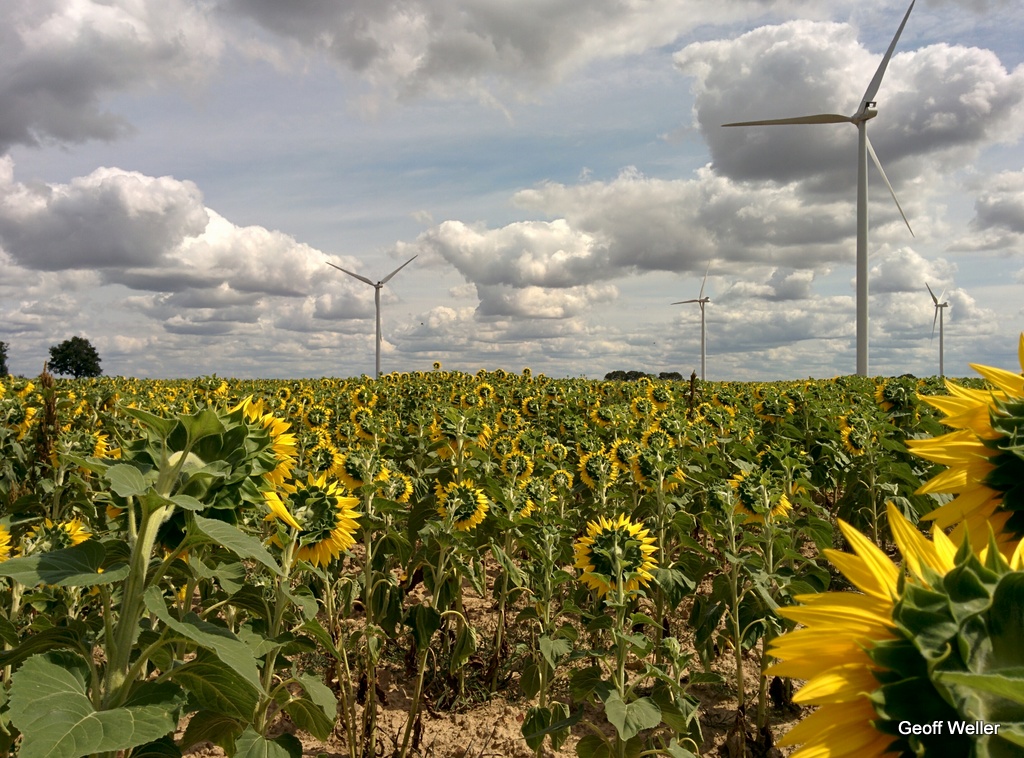
Windmills and Sunflowers
I stop for the day at Charroux. It seems to be majority English-speaking; clearly I've ridden into a bit of an English enclave in this part of France. Even the locals speak English; I guess they realise they have to since none of the English seem to speak much French. I am later to discover this is not quite a true statement when I'm sitting outside the bar - run by an Irishman - and I hear that at the table next to me, where there's a big group, some of the English are in fact speaking French.
How many feet have walked on these stones I wonder

Later I discuss the fact that so much English is spoken in the village with the owner of the restaurant where I have dinner. She says that now at least a third of the inhabitants are English and that it is causing some friction as the English are not really making an attempt at integrating.

In the evening a food van sets up outside the Tourist office, where I'm sitting on a park bench surfing on their Internet. I watch them setting up the van and I'm thinking, if that's a pizza van I'm having pizza tonight. There's a steady stream of customers, who obviously know this van. Turns out the van is run by an English couple and the customers are all local English people. They are selling hamburgers, not pizzas. No pizza for dinner then.
The Halte Jacquaire in Charroux

I'm staying at the Halte Jacquaire. It's in a restored old maison à colombages, perfect for a pilgrim refuge. The woman who looks after the place (you collect the key at the local bar) comes by to check if everything is OK. Apparently, last year, not that long after the local community bought and restored the building to encourage people on the Chemin de Compostelle to stop in the village, the powers that be decided to change the route of the Chemin and it now bypasses the village. I had already noticed that virtually all the entries in the visitor's book were Dutch cyclists (I am using the Dutch cyclists guide, which mentions this village). So I guess the French walkers are staying somewhere else nowadays, which is a shame since this is actually a pretty well-equipped and nicely-prepared place.

At the local restaurant, which is quite impressive in the old style, there is only one table occupied when I arrive. It's a party of three, and they are English. Locals, as I later discover. I am the only other diner for the evening. Beats me how these places can survive, especially as they offer quite an impressive menu selection. The food, and the wine - even by the glass -was really very good. But the owners are thinking of selling up and retiring. Already they've given up on the hotel part of the business, and if the restaurant is so poorly frequented then it's no wonder they are thinking of moving on. Who will buy a place like this? Perhaps an English couple.
The bustling restaurant in Charroux

Tomorrow it's going to be interesting to find a place to stay; the route goes through a region with little in the way of significant towns or villages and there are no pilgrim stops or hotels on the route, which is a little odd to say the least.

Wednesday, August 29, 2018

Camino v3 - Day 3: Châtellerault to Poitiers (44km)

There was a big storm last night with  impressive lightning and heavy rain. It was a welcome relief from the oppressive heat in the un-insulated old attic space of my Halte Jacquaire. The extent of the storm becomes obvious the next morning as I ride in the parks through lots of fallen branches covering the paths.
Wild garden

I've stopped because I am, in aviation parlance, uncertain of my location (pilots are never "lost", that would be bad form). Actually, I've stopped because I've ridden off the map and so need to plan a way back onto it. The area I've stopped in is rather dodgy, with obviously unkempt houses and plenty of rubbish around. Suddenly the door of the house I've stopped outside opens and a half-dressed and rather dodgy character pokes his head out to check me out. Clearly I am acting suspiciously. I'm across the road from the Fenwick factory and there's a steady stream of people converging from all directions, walking to work. Yet another moment where I realise how glad I am to not having to go to work every day anymore. Not that I disliked work, but I'm happy to longer have to.

Rain was threatening this morning although I thought I had escaped it. No such luck and about an hour into my day's ride it starts to drizzle and then steadily rain, although not heavily. I ride in the rain for hours, the sort of rain that's not really heavy enough to have your waterproof clothes on, but soaks you to the skin of you don't cover up.

After an hour or two of the rain I'm ready for a break and at Dissay I stop at a patisserie near the impressive chateau. There's a group of young people sitting there and they're impressed with my long ride. I order a quiche, decide to buy a sweet tart for the road and then spot a coffee machine. I order a coffee as well, and magically the price of my purchases drops. Questioning this I am told that since I've ordered a drink, a meal and a dessert I get the "menu" price. My coffee, which with no milk is actually not bad, is therefore costing me something like negative 50 cents.

I've decided that Wednesday must be learning to drive day. This morning when I set off in Châtellerault I ride past a couple of voiture école cars parked in a quiet street, probably waiting for their students. I'm riding along little back roads, ideal for learner drivers to keep them away from other cars I suppose. Later I notice a motorbike riding behind me. This is rather unexpected, since motorised vehicles, especially motorbikes, are normally quick to overtake. When the motorbike does finally, hesitantly, overtake I realise why he was being hesitant; he's a learner rider. Later, in a small town, four identical bikes with identically-dressed riders enter the roundabout I'm about to enter and do two circuits while their instructor in his car with bike trailer waits, holding the traffic back so his students have the roundabout to themselves. Here in France motorbike schools work by having the rider being followed by the instructor in a car, which when you think about it is not a bad concept. During my ride today I am passed by many learner drivers: it's definitely learn to drive day today.

There are blackberries everywhere along the route, often planted as fences along the paths. I finally stop to try some; they are good even if I don't know what they have been exposed to. I'll assume that since these are more or less wild, nobody has been spraying them with anything nasty. A bit later one of the villages has a sign proclaiming the area as pesticide free and bio; it's almost as if they had been reading my mind.
Only 1,372 km to Santiago

Near Poitiers I pass a house with a shell and the distance to Santiago built into the stone wall. Probably a pilgrim who's completed the journey and quite possibly indicating that this house welcomes pilgrims.

Arriving in Poitiers I am following the route into town along a small back street. Ahead of me they are working on the road and up ahead there's a guy on a steamroller who starts waving at me, pointing to the footpath. At about the same time I realise he's trying to tell me to get off the road, I start to feel the heat radiating up from the ground: I am riding on freshly-laid hot tarmac! With visions of my tyres exploding from the heat I head straight for the gutter and on to the footpath. The roadway really is hot and I beat a hasty retreat back along the footpath, which at that point is only just wide enough for the bike. I guess I won't be following the chemin in this part.

At Poitiers I head for the Tourist Office, where I get the impression they are trying to hurry me along with my requests. Then as I leave the woman closes and locks the door behind me and the penny drops. This is France; the tourist offices - counter-intuitively - close, of course, for lunch. I had been delaying their lunch break!
Bike selfie with town hall - Poitiers

Riding around the back streets in Poitiers, I am stopped outside Hotel Roynard (an old Hôtel Particulier) to read the explanatory sign about this historic building. Two small girls come out of the enormous doors with their kids' scooters. "Bonjour Monsieur. On va faire de la trottinette" by way of saying hello. So these old tourist attractions are in fact occupied. As if to make the point, there's an enormous pile of dog shit deposited right under the sign I'm reading. Poitiers is no better than Paris in this respect (worse even, if that's possible).
The statue of liberty (or at least one of them)

Since there is no pilgrim hostel in Poitiers (odd, since it's an important pilgrimage destination) and it turns out that the Youth Hostel is 3km out of town, I decide on the relative luxury of a little hotel for tonight. The hotel is right on the Chemin, which will be convenient in the morning but is inconvenient now, since I've just ridden all the way up the hill into the centre of the town and the hotel is right at the bottom of the hill on the edge of the town. The group of musicians who had apparently booked all but one of the rooms at the hotel call to cancel and I end up being the only guest in the place. I decide to have dinner there as well - partly because after walking around the town for several hours my legs are no longer really up to going back up the hill to a restaurant, and partly because the hotel restaurant looks as good as any others I would have eaten at and I want to give the guy some more business. I'm the only diner for the night as well, which brings the benefit of a custom menu and some extra red wine on the house to keep the conversation  going. And the food is actually pretty good.
Giraffes don't wear false collars and the cow jumps over the moon - Poitiers

Tuesday, August 28, 2018

Camino v3 - Day 2: Veigné to Châtellerault (72km)

Finally at Sainte-Maure-de-Touraine, after 27 km of riding, I find somewhere that serves coffee. I need a coffee to go with the croissant I bought at the local boulangerie this morning. So I order a café crème at the 'Café Bar de la Mairie', appropriately located on the main square right next to the town hall. The service is friendly and the coffee is, as I had already anticipated, awful. Why it is that as soon as milk is involved the French seem to find it so difficult to make decent coffee is beyond me. The croissant is good though.

Pole full of signs and symbols: all pointing to Santiago

Earlier, I stopped at Sainte-Catherine-de-Fierbois, at a delightfully quaint little area around the church with a statue of Jeanne d'Arc. I am taking a photo of the beautifully restored and maintained Maison de Dauphin (1415) when the window opens and an immaculately-coiffed lady pops her head out to tell that the auberge, which I am standing in front of, is closed. Then she notices my shell and a long discussion starts about the Camino; where I'm from, how she's walked most of it and she wants to do the last part from Paris "we have another house there" to her house in Sainte-Catherine (which conveniently is right on the Chemin of course). Looking at her, someone of means and immaculately presented, you wouldn't have guessed she'd be walking for hundreds of kilometres and staying in pilgrimage hostels, but you do find all types on The Way.
La Maison du Dauphin - 1415: Sainte-Catherine-de-Fierbois

It's been hot today; it is 32 degrees when I arrive in Châtellerault and having ridden four hours in the full sun at that temperature is enough for the day. Besides, after 70 km my legs are telling me it is time to stop. Despite what my guide said, it turns out that there is a Halte Jacquaire here and luckily despite not having booked, there is still place (with only four beds it wouldn't take much to be booked out). But there is just one booking for two women I am told, so there is a place for me. It turns out to be in the Hôtel Sully, one of the plus beaux hôtels particuliers in Châtellerault according to the tourist brochure. Not bad for 8 euros, and just next to the Eglise St Jacques, which of course is particularly significant for the pilgrimage.
Hôtel Sully - bed for the night

After making my bed (as the first to arrive I have my choice) using the standard supplied disposable sheets and doing my daily washing, I set off for a walk around the town, something which I soon ran out of enthusiasm for in the heat, especially after having ridden so far. So I compromise and install myself at a footpath table outside a bar serving cold beers. One has to adapt to the situation after all.
While I spend time at my footpath table with my beer, apart from observing the people (obviously) I've also been looking at the buses - really.

The buses leaving the nearby bus zone have to make a tight turn onto the road near to where I'm sitting. There are basically two ways of achieving this turn: the lazy way, allowing the rear wheels of the long bus to mount the kerb (essentially cutting the corner); or the slightly more difficult properly executed turn, making the turn wide while carefully judging the position of the front of the bus (it's a tight turn after all) so that the rear wheels stay on the roadway. Systematically, it's the female bus drivers - and there are a lot of female bus drivers in Châtellerault - who take the more correct approach while their make colleagues are all cutting the corner. 

While I am on the subject of gender-based driving stereotypes, another example of male and female driving behaviour is in the way cars come behind you when you're riding and how and when they overtake. When the car behind keeps its distance and matches your speed, following patiently until the road ahead is well clear before overtaking, it's most often a female driver. The males come rushing up and overtake when they should have waited, and if they do have to wait, they are the ones following too close behind.
Self Portrait - Châtellerault

While walking back to the pilgrim gîte I see two women of a certain age taking pictures of the Saint Jacques church. They are dressed almost identically, in hiking pants and a light top, and are both carrying fancy pouches. I ask them and sure enough the are my roommates for the night. Back at the pilgrim refuge I see there are two other beds prepared. On one of them, I cannot help but notice, plugged into the power point there's a machine which has a flexible hose attached to a mask. It looks like an oxygen / breathing machine. I suppose one of these women has a breathing problem of some sort. Imagine carrying that machine with you in your backpack every day. Later, when we are discussing the walk and comparing notes she tells me that her backpack weighs just over 10kg - even with the machine. It seems amazingly light, but she's obviously got things worked out.

Dinner tonight is a three-course French meal at a real restaurant, unlike last night's supermarket-bought-make-dinner-yourself effort. I sit outside because the advertised salle climatisée is, of course, not climatisée at all and it's hotter inside than out. Besides, there's more people to watch out here.
Saint Jacques in his church - Châtellerault

Monday, August 27, 2018

Camino v3 - Day 1: Chemillé to Veigné (66km)

Bagpipes. Not really what you'd expect to be listening to at the end of your first day's ride in France on the Chemin de Compostelle (Camino de Santiago). But here I am, sitting in a small shelter on the banks of the Indre river in Veigné, listening to someone playing bagpipes; it's the same tune over and over and it's coming from the music school which now occupies the old mill building - an attractive multi storey place on the banks of the river, with large sprays colour under every window from the boxes of geraniums. Water sluicing through the mill sluice, kids playing, cars rushing over the bridge, and bagpipes. The evening sounds of Veigné.
Setting off  - in the rain

The fishermen (why are they always men?) are packing up and walking back to their cars carrying their rods. Why is it that you never see them carrying any actual fish? It seems the attraction of fishing is not necessarily the actual catching of fish. The bells of the local church toll the hour. I can see the church spire from my riverbank vantage point; it's an interesting stone spire, quite unusual and no doubt quite an engineering feat.
Rain - and interesting skies

Today's ride, the first of this third and final phase of the Camino de Santiago, starts in the drizzle. I am tempted to postpone my departure but of course I can't do that. Mind you after two kilometres I realise that, despite my pre-departure checklist, I've forgotten to turn the water off and so have to re-trace my steps (pedals?), turn the water off, and start again. It keeps drizzling though, and does so for most of the morning, stopping only when I reach Tours. Good timing, since it allows me to sit outside with my morning (early afternoon actually) coffee at 'Le Petit Atelier', a coffee shop that actually makes decent coffee and which thankfully is still there (it's been a couple of years since I was last there.)
Patriotic tractor and wildflowers

I am seated at a table between a couple of guys on one side and a couple of girls on the other. The guy is explaining, in French of course, to his companion that he'd rather learn to speak two dead languages (Latin and ?) than speak English. As I have come in part way through their conversation I am of course missing the context of this statement. He looks across at my coffee (a decent flat white complete with latte art) and comments to his companion on how nice it looks. So I take the opportunity to explain to him that it was called a 'flat white' noting that occasionally it actually comes in handy to know some English. "I'm English" he says (in French). This statement is somewhat unexpected, given his earlier comment. "Half Polish and half English - and half French" he adds, by way of explanation. At which point my female neighbour on my other side (covered in tattoos and who is obviously listening in) joins in to explain what an impossibly complex language Polish is. She then notices the Coquille St. Jacques (the symbol of the Camino de Santiago) I have on my bike and we have a conversation about the pilgrimage and its history. It is an interesting first coffee stop.

Later, leaving Tours, I am greeted by a guy calling out: "Buen Camino" - taking me back four years to my first Camino, in Spain, where you heard this repeatedly throughout the day. It really is an interesting start to the journey.
Self Portrait and confirmation that I'm on the right track

At Veigné, about 20 km south of Tours, I've had enough for the day. I know there is a pilgrim's "gîte" in the town, so I go to the local Mairie (town hall) and sure enough, they have the key. For the princely sum of 5 euros I have a bed for the night, as well as the first stamp for my credencial (pilgrim's passport) for this trip.
My first night's accommodation

My room mates are an older (probably about my age if truth be told) woman and her impossibly skinny son. "He's difficult" she explains when he left the room, "but aren't all children?" She has walked all day to arrive in Veigné and meet up with him; he has arrived by car. Their plan is to walk together for several days (I get the impression it is to be a bit of a bonding exercise) although he doesn't appear to be at all prepared. I think this may have prompted, at least in part, her "difficult" comment.

It's Monday and, of course, all the restaurants in town - there are not that many - are closed, including the one at the local camping ground which according to the person at the Mairie would be open. So it's back on the bike again to ride to the next town - a few kilometres away - to the closest supermarket which is open, to buy some things to make myself dinner. So my first night of the Chemin de Compostelle is appropriately spent in a pilgrim refuge making my own dinner.
Veigné - music school (with bagpipes)